Law 1 – The Pitch
1. Pitch surface
Section titled “1. Pitch surface”The surface of the pitch must be flat, smooth and non-abrasive, and should preferably be made of wood. Dangerous surfaces for players, team officials and match officials are not permitted.
For competition matches between representative teams of national associations affiliated to FIFA or international club competition matches, it is recommended that the futsal floor be produced and installed by a company officially licensed under the FIFA Quality Programme for Futsal Surfaces and carrying one of the following quality labels:


Artificial turf pitches are permitted in exceptional cases but only for domestic competitions and if specified in the competition rules.
2. Pitch markings
Section titled “2. Pitch markings”The pitch must be rectangular and marked with continuous lines (broken lines are not permitted), which must not be dangerous (i.e. they must be non-slippery). These lines belong to the areas of which they are boundaries and must be clearly distinguishable from the colour of the pitch.
Only the lines indicated in Law 1 are to be marked on the pitch.
Where a multipurpose hall is used, other lines are permitted provided that they are a different colour and clearly distinguishable from the futsal lines.
If a player makes unauthorised marks on the pitch, the player must be cautioned for unsporting behaviour. If the referees notice this being done during the match, play must be stopped, if they cannot apply the advantage, and the offending player must be cautioned for unsporting behaviour. Play is restarted with an indirect free kick to the opposing team from the position of the ball when play was stopped, unless the ball was inside the penalty area (see Law 13).
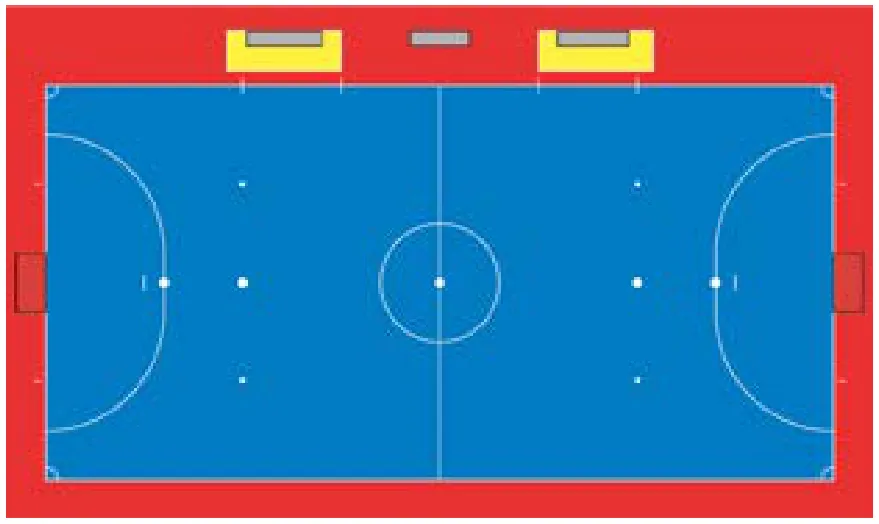
The two longer boundary lines are touchlines. The two shorter lines are end lines. The part of each end line between the normal position of the goalposts is designated as the goal line.
The pitch is divided into two halves by a halfway line, which joins the midpoints of the two touchlines.
The centre mark, with a radius of 6cm, is indicated at the midpoint of the halfway line. A circle with a radius of 3m is marked around it.
A mark must be drawn outside the pitch, 5m from each corner arc, at right angles to the end line and separated from the end line by a gap of 5cm, to ensure that defending-team players retreat the minimum distance (5m) when a corner kick is being taken. This mark is 8cm wide and 40cm long.
3. Pitch dimensions
Section titled “3. Pitch dimensions”The touchline must be longer than the end line. All lines must be 8cm wide.
For non-international matches, the dimensions are as follows:
Length (touchline): Minimum 25m
Maximum 42m
Width (end line): Minimum 16m
Maximum 25m
For international matches, the dimensions are as follows:
Length (touchline): Minimum 38m
Maximum 42m
Width (end line): Minimum 20m
Maximum 25m
Competition rules may determine the length of the end line and touchline within the
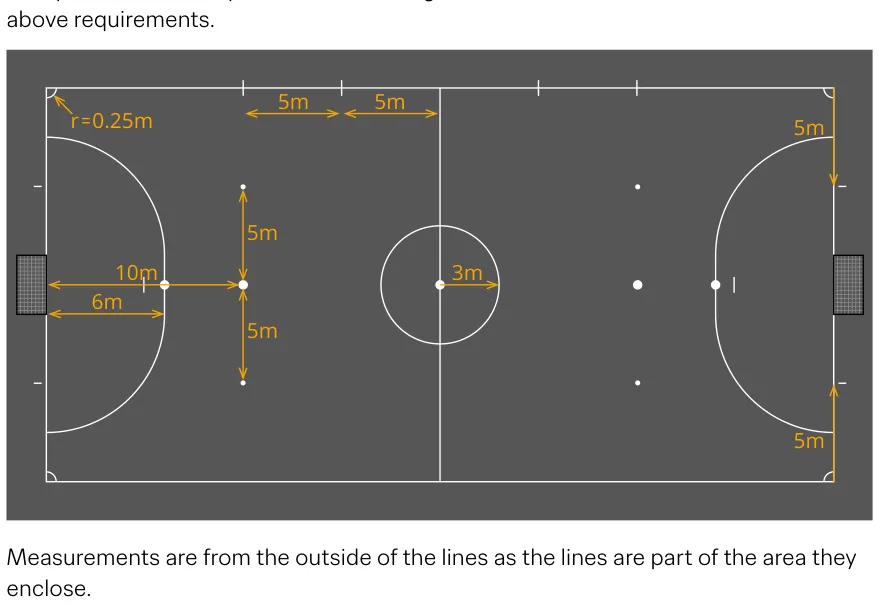
The penalty mark is measured from the centre of the mark to the back edge of the goal line.
The 10m mark is measured from the centre of the mark to the back edge of the goal line.
The 5m mark in the penalty area, denoting the distance to be observed by the goalkeeper at a direct free kick beginning with a sixth accumulated foul (DFKSAF), is measured from the centre of the 10m mark to the back edge of the 5m mark (i.e. the edge closer to the goal line).
4. The penalty area
Section titled “4. The penalty area”Two imaginary lines of 6m in length are drawn from the outside of each goalpost and at right angles to the end line. At the end of these lines, a quarter circle is drawn in the direction of the nearest touchline, each with a radius of 6m from the outside of the goalpost. The upper part of each quarter circle is joined by a line of 3.16m in length, running parallel to the goal line. The area bounded by these lines and the end line is
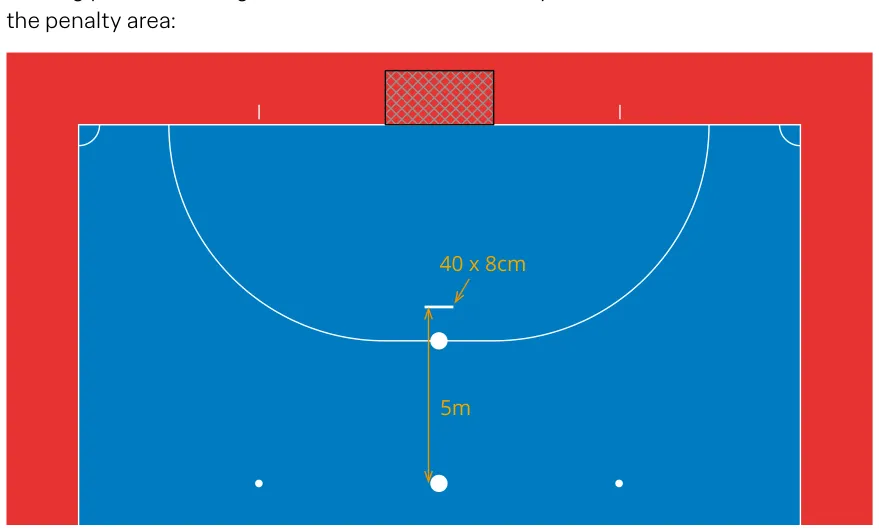
Within each penalty area, a penalty mark is made 6m from the midpoint between the goalposts and equidistant to them. This is a circular mark with a radius of 6cm.
An additional mark (line) must be made in the penalty area, 5m from the 10m mark, to ensure that the defending goalkeeper observes this distance when a DFKSAF is being taken. This mark is 8cm wide and 40cm long.
5. The 10m mark
Section titled “5. The 10m mark”A second mark is made 10m from the midpoint between the goalposts and equidistant to them. This is a circular mark with a radius of 6cm.
Two additional marks, respectively at a distance of 5m either side of the 10m mark, must be made on the pitch to indicate the minimum distance that players must observe when a kick is being taken from the 10m mark. These are circular marks with a radius of 4cm each.
An imaginary line passing through these marks, 10m from and parallel to the end line, marks the boundary of the area where, if a DFKSAF offence is committed therein, teams may choose between taking the DFKSAF from the 10m mark or from the place where the offence was committed.
6. The substitution zones
Section titled “6. The substitution zones”The substitution zones are the areas on the touchline in front of the team benches:
- They are situated in front of the technical areas, 5m from the halfway line, and are 5m in length. They are marked at each end with a line of 80cm in length, 40cm of which is drawn on the pitch and 40cm off the pitch, and 8cm in width.
- A team’s substitution zone is situated in the half of the pitch defended by the said team. Each team’s substitution zone changes in the second half of the match and any required periods of extra time.
More details on substitutions and the relevant procedure are provided in Law 3.
7. The corner area
Section titled “7. The corner area”A quarter circle with a radius of 25cm is drawn inside the pitch from each corner. The line (the corner arc) has a width of 8cm.
8. The technical area
Section titled “8. The technical area”The technical area features a designated sitting area for team officials and substitutes. While the size and position of technical areas may differ between facilities, the following guidelines apply:
- The technical area should only extend 1m on either side of the designated sitting area and forwards up to a distance of 75cm from the touchline.
- Markings should be used to define the area.
- The number of persons permitted to occupy the technical area is defined by the competition rules.
- The occupants of the technical area:
- are identified before the start of the match in accordance with the competition rules;
- must behave in a responsible manner;
- must remain within its confines except in special circumstances, e.g. a physiotherapist/doctor entering the pitch, with one of the referees’ permission, to assess an injured player.
- Only one person at a time is authorised to stand and convey tactical instructions from the technical area.
- The substitutes and the fitness coach may warm up during a match in the zone provided for this purpose behind the technical area. If such a zone is not available, they may warm up near the touchline as long as they do not obstruct the movement of the players and referees and they behave responsibly.
Substitution zone and technical area
Section titled “Substitution zone and technical area”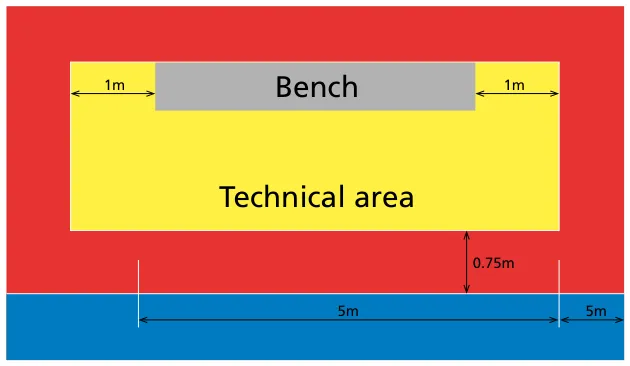
Safety
Section titled “Safety”The competition rules must state the minimum distance between the boundary lines of the pitch (touchlines and end lines) and the barriers separating the spectators (including the barriers with advertising, etc.), always in such a way as to ensure the safety of the participants.
9. The goals
Section titled “9. The goals”A goal must be placed at the centre of each end line.
A goal consists of two upright posts equidistant from the corners of the pitch and joined at the top by a horizontal crossbar. The goalposts and crossbar must be made of approved material and must not be dangerous.
The goalposts and crossbar of both goals must be the same shape, which must be square, rectangular, round, elliptical or a hybrid of these options.
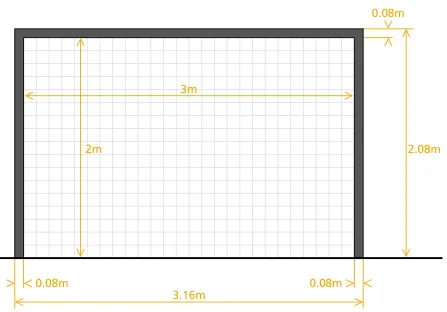
The distance (inside measurement) between the posts is 3m and the distance from the lower edge of the crossbar to the floor is 2m.
Both goalposts and the crossbar have the same width and depth as the end lines, 8cm. Nets made of an adequate material must be attached to the back of the goalposts and the crossbar with a suitable means. They must be properly supported and must not interfere with the goalkeeper.
It is recommended that all goals used in an official competition organised under the auspices of FIFA or confederations not include any extraneous structures (i.e. except for the goalposts and crossbar – e.g. support bars) that could prevent the ball from going into the goal.
If the crossbar becomes displaced or broken, play is stopped until it has been repaired or replaced in position. If it is not possible to repair the crossbar, the match must be abandoned. The use of a rope to replace the crossbar is not permitted. If the crossbar can be repaired, the match is restarted with a dropped ball (see Law 8).
The goalposts and crossbars must be of a different colour to the pitch.
Goals must not be fixed to the floor, as this could endanger the safety of the participants. However, they must have an adequate stabilising system, such as weight placed at the back of the goal, to prevent them from overturning.
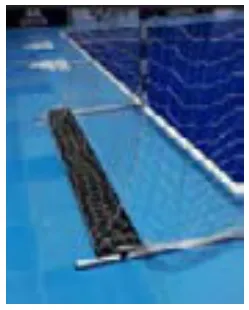
Portable goals may only be used if they satisfy this requirement.
10. Goal movement
Section titled “10. Goal movement”Referees are required to utilise the following guidelines regarding the placement of the goals along the end line and the scoring of a goal:
Goal positioned correctly
Section titled “Goal positioned correctly”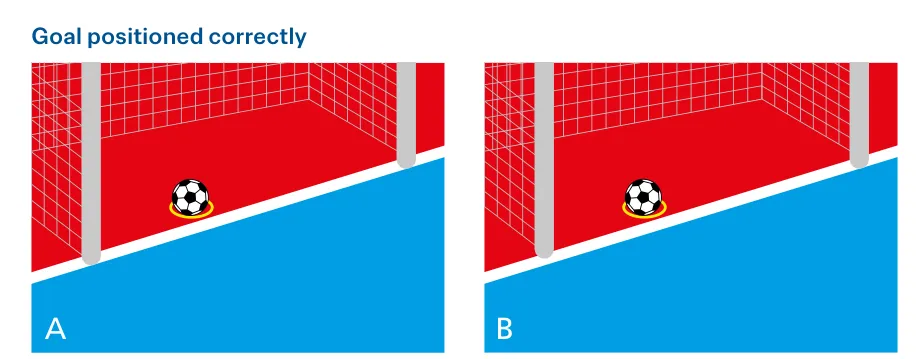
Goal moved
Section titled “Goal moved”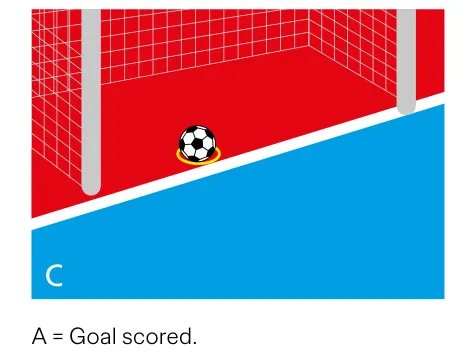
B = If both goalposts are touching the end line, referees must allow the goal if the ball has completely crossed the goal line.
C = A goal is considered to have moved when at least one of the goalposts is not touching the end line in the normal position.
In the event that the goal is moved or overturned, whether the ball has entered the goal is determined by whether it has wholly passed over the goal line between where the goalposts would normally be positioned and under the crossbar with or without the ball touching the goalposts or crossbar. If the goal is overturned, this includes the normal height of the crossbar.
If a defending-team player (including the goalkeeper) moves or overturns their own goal and:
- the ball does not enter or touch the goal, play is stopped and:
- if it was accidental, the match is restarted with a dropped ball;
- if it was deliberate, the match is restarted with an indirect free kick and the offending player must be cautioned.
- the ball touches but does not enter the goal, play is stopped and:
- if it was accidental, the match is restarted with a dropped ball;
- if it was deliberate, the match is restarted with a penalty kick and the offending player must be sent off for denying the opposing team a goal or an obvious goalscoring opportunity.
- the ball enters the goal, a goal is allowed and the offending player must be cautioned if it was deliberate.
If an attacking-team player moves or overturns the opponents’ goal accidentally or deliberately, a goal must not be allowed and:
- if it was accidental, the match is restarted with a dropped ball;
- if it was deliberate and the goal made contact with the ball, a direct free kick is awarded to the opposing team and the player must be cautioned;
- if it was deliberate and the goal did not make contact with the ball, an indirect free kick is awarded to the opposing team and the player must be cautioned.
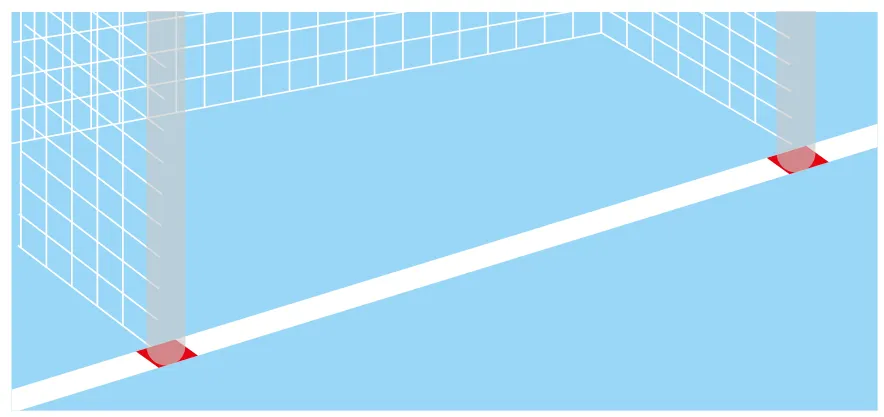
Additional marks may be made under the goalposts to help the referees to ensure that a moved goal is returned to the correct position.
11. Advertising, logos and emblems on the pitch
Section titled “11. Advertising, logos and emblems on the pitch”If the competition rules do not prohibit them, advertising and the reproduction, whether physical or virtual, of representative logos or emblems of FIFA, confederations, national football associations, competitions, clubs or other bodies on the floor of the pitch and the technical areas are permitted, provided that they do not distract or confuse the players or match officials. All such advertising, logos and emblems must be at least 0.75m away from the boundary lines, and no advertising, logos or emblems is/are permitted on any pitch markings, except on the halfway line outside the centre circle.
12. Advertising on the goal nets
Section titled “12. Advertising on the goal nets”If the competition rules do not prohibit it, advertising on the goal nets is permitted, provided that it does not confuse, or obstruct the view of, the players or referees.
13. Advertising in the technical areas
Section titled “13. Advertising in the technical areas”If the competition rules do not prohibit it, advertising on the floor of the technical areas is permitted, provided that it does not distract or confuse the occupants of the said areas or any other participant.
14. Advertising around the pitch
Section titled “14. Advertising around the pitch”Upright advertising must be at least:
- 1m from the touchlines, except in the technical areas and substitution zones, in which all upright advertising is prohibited;
- the same distance from the end line as the depth of the goal net;
- 1m from the goal net.
15. Background music and sound effects
Section titled “15. Background music and sound effects”Background music and sound effects are permitted during the match; however, they must not drown out or interfere with the referees’ whistles or the acoustic signal/whistle used by the timekeeper or hinder communication between or among players, substitutes, team officials and/or match officials.