Law 13 – Free Kicks
1. Types of free kick
Section titled “1. Types of free kick”Direct and indirect free kicks are awarded to the opposing team of a player, substitute, sent-off player or team official guilty of an offence.
The four-second count must be shown clearly by one of the referees when a direct or indirect free kick is taken.
Indirect-free-kick signal
Section titled “Indirect-free-kick signal”The referees indicate an indirect free kick by raising one arm above the head; this signal is maintained until the kick has been taken and the ball touches another player or goes out of play.
An indirect free kick must be retaken if either or both of the referees fail(s) to signal that the kick is indirect and the ball is kicked directly into the goal.
Ball enters the goal
Section titled “Ball enters the goal”- If a direct free kick is kicked directly into the opponents’ goal, a goal is awarded.
- If an indirect free kick is kicked directly into the opponents’ goal, a goal clearance is awarded to the opponents (unless the indirect-free-kick signal was not made by either or both of the referees).
- If a direct or indirect free kick is kicked directly into the kicker’s own goal, a corner kick is awarded to the opponents.
2. Procedure
Section titled “2. Procedure”All free kicks must be taken:
- within four seconds;
- from the place where the offence occurred, except:
- free kicks to the defending team in its penalty area, which may be taken from anywhere in that area;
- indirect free kicks for an offence committed by the defending team inside its own penalty area or for an applicable offence when play was stopped with the ball inside the defending team’s penalty area, which are taken from the penalty-area line at the point nearest to the place where the offence was committed or the ball was located, following an imaginary line parallel to the touchline (as illustrated in
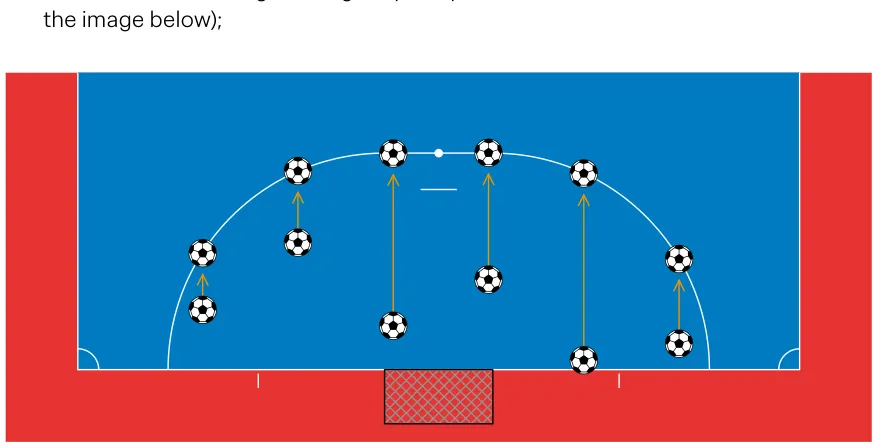
- indirect free kicks for offences involving a player entering, re-entering or leaving the pitch without permission, which are taken from the position of the ball when play was stopped, unless play was stopped with the ball inside the penalty area, in which case the free kick is to be taken from the penalty-area line at the point nearest to the place where the ball was located when play was stopped, following an imaginary line parallel to the touchline (see the image above). However, if a player commits an offence off the pitch (except against an outside agent), play is restarted with a free kick taken from the point on the boundary line nearest to where the offence occurred; a penalty kick is awarded if this is a direct-free-kick offence and the closest boundary-line point lies on the part of the end line that belongs to the offender’s penalty area;
- where the Law designates another position.
The ball:
Section titled “The ball:”- must be stationary and the kicker must not touch it again until it has touched another player;
- is in play when it is kicked and clearly moves.
Until the ball is in play, all opponents must remain:
- at least 5m from the ball;
- outside the penalty area for free kicks inside the opponents’ penalty area.
Where two or more defending-team players form a “wall”, all attacking-team players must remain at least 1m from the “wall” until the ball is in play.
A free kick can be taken by lifting the ball with a foot or with both feet simultaneously. Feinting to take a free kick is permitted as part of futsal.
If a player, while correctly taking a free kick, deliberately kicks the ball at an opponent in order to play the ball again but not in a careless or reckless manner or using excessive force, the referees allow play to continue.
3. Offences and sanctions
Section titled “3. Offences and sanctions”If, when a free kick is taken, an opponent is closer to the ball than the required distance, the kick is retaken unless the advantage can be applied; notwithstanding, if a player takes a free kick quickly and an opponent who is closer than 5m from the ball intercepts it, the referees allow play to continue. However, an opponent who deliberately prevents a free kick from being taken quickly must be cautioned for delaying the restart of play.
If, when a free kick is taken, an attacking-team player is less than 1m from a ”wall” formed by two or more defending-team players, an indirect free kick is awarded to the defending team.
If, when a free kick is taken by the defending team inside its penalty area, any opponents are inside the penalty area because they did not have time to leave, the referees allow play to continue.
If an opponent who is in the penalty area when the free kick is taken, or who enters the penalty area before the ball is in play, touches or challenges for the ball before it is in play, the free kick is retaken.
If, after the ball is in play, the kicker touches the ball again before it has touched another player, an indirect free kick is awarded; if the kicker commits a handball offence:
- a direct free kick is awarded;
- a penalty kick is awarded if the offence occurred inside the kicker’s penalty area, unless the kicker was the goalkeeper, in which case an indirect free kick is awarded.
If, after the ball is in play, the kicker leaves the pitch and is replaced by a substitute (in accordance with the substitution procedure) who then touches the ball before it has been touched by another player, an indirect free kick is awarded to the opposing team, to be taken from the place where the ball was touched by the player who has just entered the pitch, unless this was inside the player’s own penalty area. In the latter case, the indirect free kick is awarded to the opposing team on the penalty-area line at the point nearest to the place where the offence was committed, following an imaginary line parallel to the touchline (see the image in section 2 of this Law).
If the free kick is not taken within four seconds, an indirect free kick is awarded to the opposing team from the place where the kick was to be taken, except when a team commits such an offence inside its own penalty area; in that case, the indirect free kick is awarded to the opposing team on the penalty-area line at the point nearest to the place where the offence was committed, following an imaginary line parallel to the touchline (see the image in section 2 of this Law).
4. Accumulated fouls
Section titled “4. Accumulated fouls”Accumulated fouls are those penalised with a direct free kick, as specified in Law 3, Law 4 and Law 12.
The accumulated fouls committed by each team in each period are recorded in the match report.
The referees may allow play to continue by applying the advantage if the offending team has not previously committed five accumulated fouls and the opposing team is not denied a goal or an obvious goalscoring opportunity.
If they apply the advantage, the referees should use the mandatory signals to indicate an accumulated foul to the timekeeper and third referee as soon as the ball is out of play.
If extra time is played, accumulated fouls from the second period of the match continue to count during extra time.
5. Direct free kick beginning with the sixth accumulated foul by each team in each period (DFKSAF)
Section titled “5. Direct free kick beginning with the sixth accumulated foul by each team in each period (DFKSAF)”A direct free kick beginning with the sixth accumulated foul is awarded for the sixth accumulated foul and all subsequent such fouls committed by a team in each period. However, if the sixth or subsequent accumulated foul is committed inside the offender’s penalty area, a penalty kick is awarded instead.
A goal may be scored directly from a DFKSAF and the kicker must attempt to do so.
The defending team’s players may not form a “wall” to defend a DFKSAF.
Procedure
Section titled “Procedure”- The ball must be stationary with part of the ball touching or overhanging the centre of the 10m mark or at the place where the DFKSAF offence was committed (provided that this was in the area between the defending team’s end line and the imaginary line outside the penalty area, 10m from and parallel to the end line).
- If the DFKSAF offence was committed in this area, the kicker may choose to take the DFKSAF either from the 10m mark or from the place where the offence was committed.
- The goalposts, crossbar and goal net must not be moving.
- The player taking the DFKSAF must be clearly identified.
- The defending goalkeeper must be at least 5m away from the ball until it has been kicked and must not behave in a way that unfairly distracts the kicker, e.g. delay the taking of the kick or touch the goalposts, crossbar or goal net.
- The players, other than the kicker and defending goalkeeper, must be:
- on the pitch;
- at least 5m from the ball;*
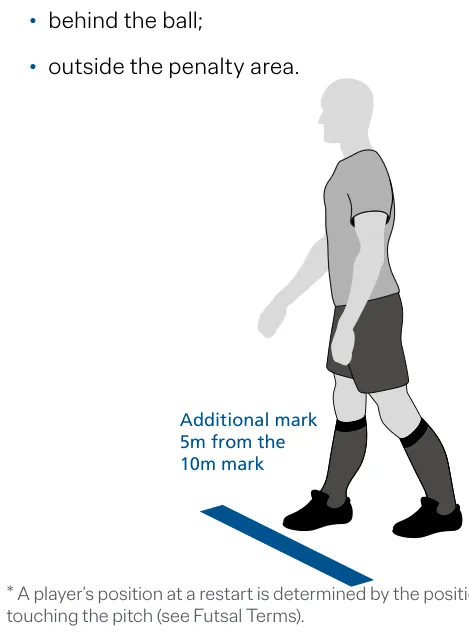
- After the players have taken positions in accordance with this Law, one of the referees signals for the DFKSAF to be taken.
- The player taking the DFKSAF must kick the ball towards the opponents’ goal and with the intention of scoring a goal directly; back-heeling is permitted provided the ball moves towards the opponents’ goal and it is an attempt to score directly.
- The ball is in play when it is kicked and clearly moves towards the opponents’ goal.
- The kicker must not play the ball again until it has touched another player.
- If a DFKSAF is awarded when a period is about to end, the period will be considered to have ended when the DFKSAF has been completed. The kick is considered completed when, after the ball is in play, one of the following occurs:
- the ball stops moving or goes out of play;
- the ball is played by any player (including the kicker) other than the defending goalkeeper;
- the referees stop play for an offence by the kicker or a team-mate of the kicker.
Offences and sanctions
Section titled “Offences and sanctions”Once the referees have signalled for a DFKSAF to be taken, the kick must be taken within four seconds. If the kick is not taken within four seconds, an indirect free kick is awarded to the opposing team from the place where the kick was to be taken.
Encroachment by players (except the defending-team goalkeeper)
Section titled “Encroachment by players (except the defending-team goalkeeper)”- A team-mate of the player taking the DFKSAF is penalised for encroachment only if:
- the encroachment clearly impacted on the goalkeeper; or
- the encroaching player plays the ball or challenges an opponent for the ball and then scores, attempts to score or creates a goalscoring opportunity.
- A team-mate of the goalkeeper is penalised for encroachment only if:
- the encroachment clearly impacted on the kicker; or
- the encroaching player plays the ball or challenges an opponent for the ball and this prevents the opponents from scoring, attempting to score or creating a goalscoring opportunity.
If a team-mate of the goalkeeper is penalised for encroachment, they are warned for the first offence in the game and cautioned for any subsequent offence(s) in the game.
If, before the ball is in play, one of the following occurs:
Section titled “If, before the ball is in play, one of the following occurs:”- the player taking the DFKSAF or a team-mate commits an offence:
- if the ball enters the goal, the kick is retaken;
- if the ball does not enter the goal, the referees stop play and restart with an indirect free kick to the opposing team;
except for the following situations, when play will be stopped and restarted with an indirect free kick to the opposing team, regardless of whether or not a goal is scored:
- a DFKSAF is not kicked towards the opponents’ goal and with the intention of
scoring a goal directly;
- a team-mate of the identified kicker takes the kick: the referees caution the
player who took the kick;
- the kicker feints to kick the ball after having completed the run-up (feinting in
the run-up is permitted): the referees caution the kicker.
- the defending goalkeeper commits an offence:
- if the ball enters the goal, a goal is awarded;
- if the ball misses the goal or rebounds from the crossbar or goalpost(s), the kick is only retaken if the goalkeeper’s offence clearly impacted on the kicker;
- if the ball is prevented from entering the goal by the goalkeeper, the kick is retaken.
If the goalkeeper’s offence results in the kick being retaken, the goalkeeper is warned for the first offence in the game and cautioned for any subsequent offence(s) in the game.
- a team-mate of the defending goalkeeper commits an offence:
- if the ball enters the goal, a goal is awarded;
- if the ball does not enter the goal, the kick is retaken; the offender is warned for the first offence in the game. If the same player commits any subsequent offence(s) in the game, they are cautioned.
- a player of both teams commits an offence, the kick is retaken unless a player commits a more serious offence (e.g. illegal feinting); the offenders are warned for the first offence in the game. If the same players commit any subsequent offence(s) in the game, they are cautioned. If a player commits a more serious offence, an indirect free kick is awarded to the opponents and the offender is cautioned without warning.
- both the defending goalkeeper and the kicker commit an offence at the same time, the kicker is cautioned and play restarts with an indirect free kick to the defending team.
An opponent who obstructs the kicker from moving towards the ball when a DFKSAF is going to be taken must be cautioned, even if the offender was respecting the 5m minimum distance.
If, after the DFKSAF has been taken:
Section titled “If, after the DFKSAF has been taken:”- the kicker touches the ball again before it has touched another player:
- an indirect free kick (or a direct free kick for a handball offence) is awarded to the opposing team.
- the ball is touched by an outside agent as it moves towards the opponents’ goal:
- the kick is retaken unless the ball is going into the goal and the interference does not prevent the defending goalkeeper or a defending-team player from playing the ball, in which case the goal is awarded if the ball enters the goal (even if contact was made with the ball) unless the interference was by the attacking team.
- the ball rebounds into the pitch from the goalkeeper, the crossbar or the goalposts and is then touched by an outside agent:
- the referees stop play;
- play is restarted with a dropped ball at the position where the ball touched the outside agent.
6. DFKSAF summary table
Section titled “6. DFKSAF summary table”Outcome of the direct free kick beginning with the sixth accumulated foul (DFKSAF)
| Offence | Ball enters goal | Ball does not enter goal |
|---|---|---|
| Encroachment by attacking-team player | Impact: DFKSAF is retaken | Impact: Indirect free kick to defending team |
| No impact: Goal | No impact: No retake | |
| Encroachment by defending-team player | Goal | Impact: DFKSAF is retaken and warning for defending-team player; caution for any further offence(s) |
| No impact: No retake | ||
| Encroachment by defending- and attacking-team player | Impact: DFKSAF is retaken and warning for offending players; caution for any further offence(s) | Impact: DFKSAF is retaken and warning for offending players; caution for any further offence(s) |
| No impact: Goal | No impact: No retake | |
| Offence by goalkeeper | Goal | Not saved: DFKSAF is not retaken (unless kicker is clearly impacted) |
| Saved: DFKSAF is retaken and warning for goalkeeper; caution for any further offence(s) | ||
| Goalkeeper and kicker commit offence at same time | Indirect free kick to defending team and caution for kicker without warning | |
| Ball not kicked towards opponents’ goal and with intention of scoring directly | Indirect free kick to defending team | |
| Kick not taken within four seconds | Indirect free kick to defending team | |
| Illegal feinting | Indirect free kick to defending team and caution for kicker without warning | |
| Wrong kicker (not identified) | Indirect free kick to defending team and caution for wrong kicker without warning | |