Practical Guidelines – Positioning
1. Positioning with the ball in play
Recommendations:
- Play should be between the referee and the second referee.
- The referees should use a diagonal system.
- Staying outside and parallel to the touchline makes it easier to keep the play and the other referee within each respective referee’s field of vision.
- The referee nearest to the play (the “action area”, i.e. the place where the ball is located at any given moment) should be within the other referee’s field of vision, and the latter should focus on controlling the “influence area” (the place where the ball is not located at that moment but where an offence or a foul is likely to occur).
- One of the referees should be close enough to see play without interfering with it.
- The referees only enter the pitch to obtain a better view of the play.
- “What needs to be seen” is not always in the vicinity of the ball. The referees should also pay attention to:
- aggressive individual player confrontations off the ball;
- possible offences in the penalty area towards which play is heading;
- offences occurring after the ball is played away;
- the next phase of play.
2. General positioning during the match
It is recommended that one of the referees be in line with, or behind, the second-last defending-team player or the ball if it is nearer the end line than the second-last defending-team player.
The referees must always face the pitch. One of the referees should control the action area and the other referee should control the influence area.
3. Goalkeeper releasing the ball
One of the referees must take a position in line with the goalkeeper and check that the goalkeeper does not touch the ball a second time after putting it into play or with the hands or arms outside the penalty area, while also timing the number of seconds for which the goalkeeper is in possession of the ball.
The same position should be taken by one of the referees for a goal clearance. The four-second count will start if the goalkeeper is inside their own penalty area. A goalkeeper who is outside their own penalty area may be cautioned for delaying the restart of play.
Once the goalkeeper has released the ball, the referees take suitable positions for controlling the match.
4. “Goal/no goal” situations
When a goal has been scored and there is no doubt about the decision, the referee and the second referee must make eye contact and the referee nearest to the timekeeper’s table must approach the timekeeper and the third referee to communicate the number of the player who scored the goal with the mandatory signal.
If a goal has been scored but play has continued because the situation is unclear, the referee nearest to the goal blows the whistle to attract the attention of the other referee, and then the referee nearest to the timekeeper’s table approaches the timekeeper and the third referee to communicate the number of the player who scored the goal with the mandatory signal.
When a team is playing with a flying goalkeeper, the third or fourth referee should assist the on-pitch referees by taking a position on the end line of the team playing with the flying goalkeeper in order to have a better view of goal/no goal situations.
5. Positioning in ball-out-of-play situations
The best position is one from which the referees can make the right decision and have the optimal view of play and the players. All recommendations about positioning are based on probabilities, which must be adjusted using specific information about the teams, the players and the events in the match up to that point.
6. Positioning off the end line when video support (VS) is in use
When VS is in use and a match official takes a position to check whether the ball enters the goal, such as at a penalty kick, DFKSAF or corner kick or during penalties (penalty shoot-out), they should stand off the end line to avoid obstructing the VS camera(s), particularly the view of the goal line.
7. Positioning in specific scenarios
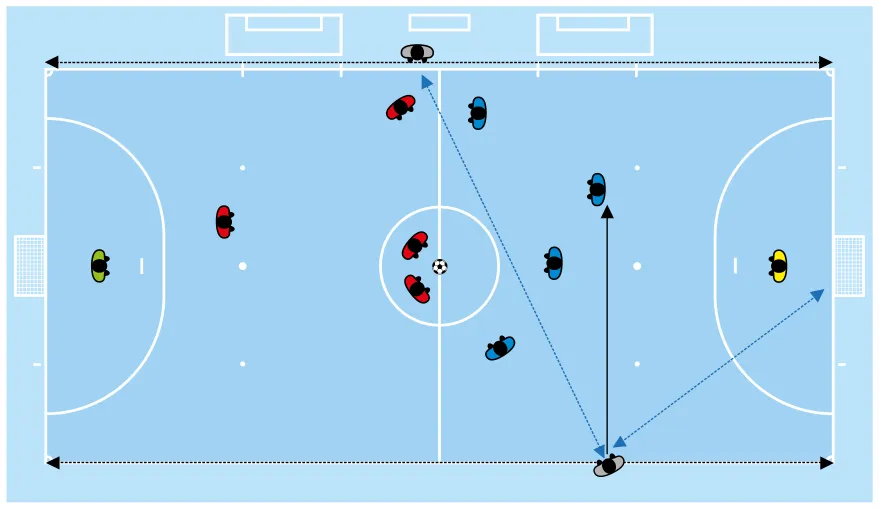
1. Positioning – kick-off
Section titled “1. Positioning – kick-off”At every kick-off, one of the referees must be situated on the same touchline as where the substitution zones are located, 1m along from the halfway line on the side of the team taking the kick-off, to check that the kick-off is taken in accordance with the established procedure.
The other referee must be on the other touchline, in line with the second-last player from the team not taking the kick-off.
2. Positioning – goal clearance
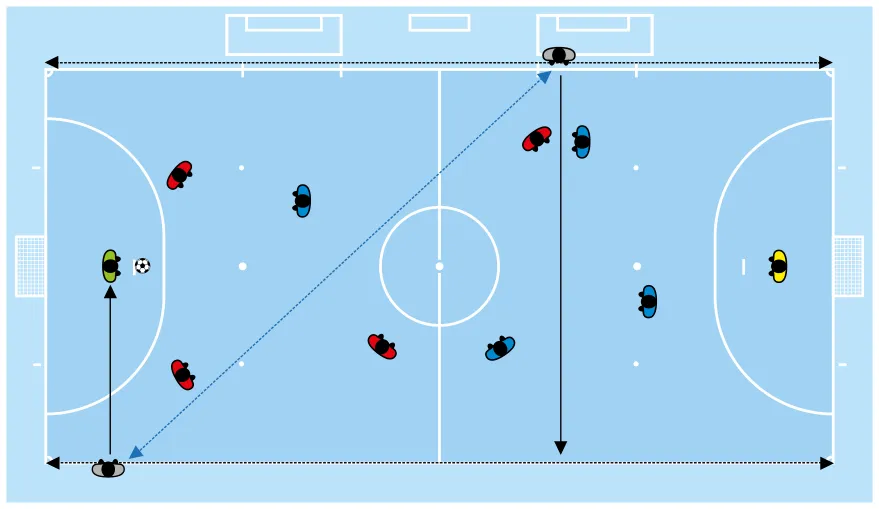
Section titled “2. Positioning – goal clearance”- One of the referees must first check if the ball is inside the penalty area. If the ball
is not inside the area, the referees may start the four-second count if they consider that the goalkeeper is ready to take the goal clearance or is delaying picking up the ball for tactical reasons.
- When the ball is inside the penalty area, one of the referees must take a position in
line with the goalkeeper to check that the goalkeeper is ready to put the ball into play and that the opposing team’s players are outside the penalty area. The referees then signal the four-second count, unless it has already started in accordance with the previous point.
- Finally, whichever of the on-pitch referees supervised the goal clearance must take
a suitable position to control the match, which is a priority in all cases.
3. Positioning – corner kick (1)
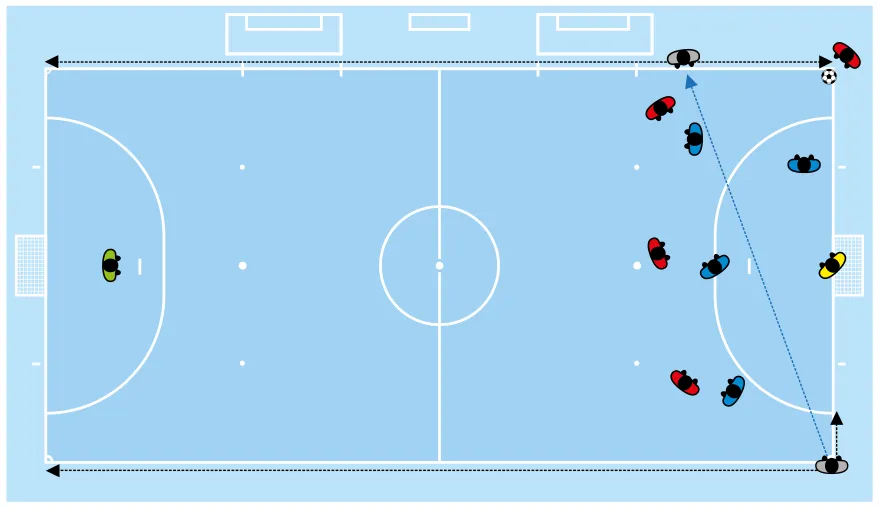
Section titled “3. Positioning – corner kick (1)”At a corner kick, the referee nearest to the location of the kick takes a position on the touchline at a distance of approximately 5m from the corner arc where the kick is to be taken. From this position, this referee must check that the ball is properly placed inside the corner area and that the defending-team players are at least 5m away from the corner arc. The other referee takes a position at the same end of the pitch but on the other side, at the intersection of the touchline and the end line. From this position, this referee watches the ball and the behaviour of the players.
4. Positioning – corner kick (2)
Section titled “4. Positioning – corner kick (2)”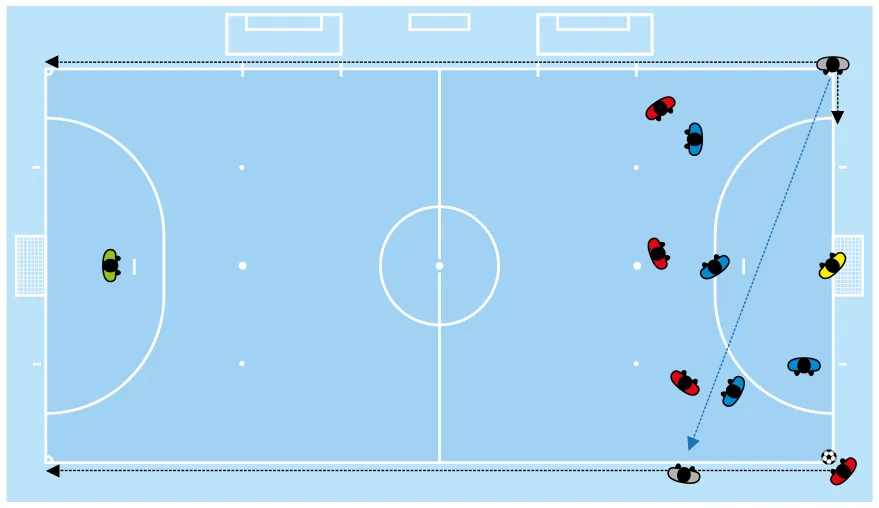
5. Positioning – free kick (1)
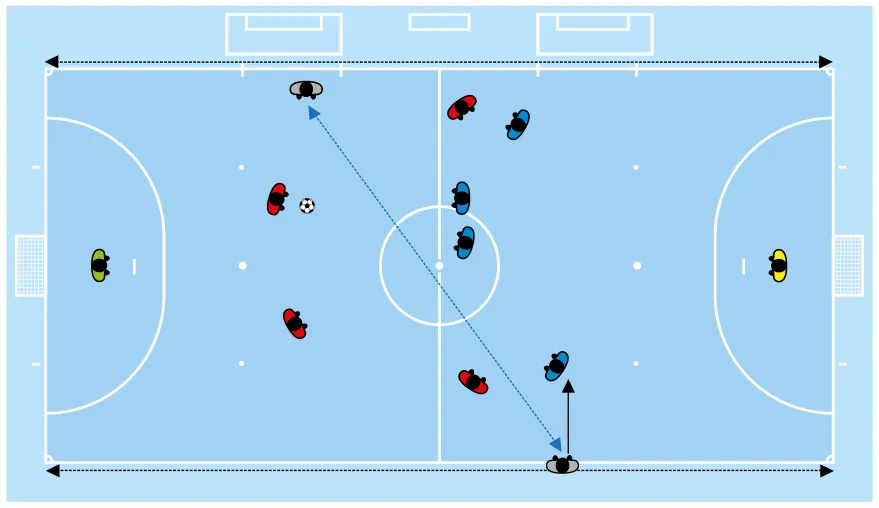
Section titled “5. Positioning – free kick (1)”At a free kick, the nearest referee takes a position in line with the place from where the kick is to be taken and checks that the ball is properly placed, as well as watching the players for encroachment while the kick is being taken. The other referee must take a position in line with the second-last defending-team player or the end line, which is a priority in all cases. Both referees must be ready to follow the trajectory of the ball and run along the touchlines towards the corners of the pitch if a direct free kick is taken towards the goal and they are not in line with the end line.
6. Positioning – free kick (2)
Section titled “6. Positioning – free kick (2)”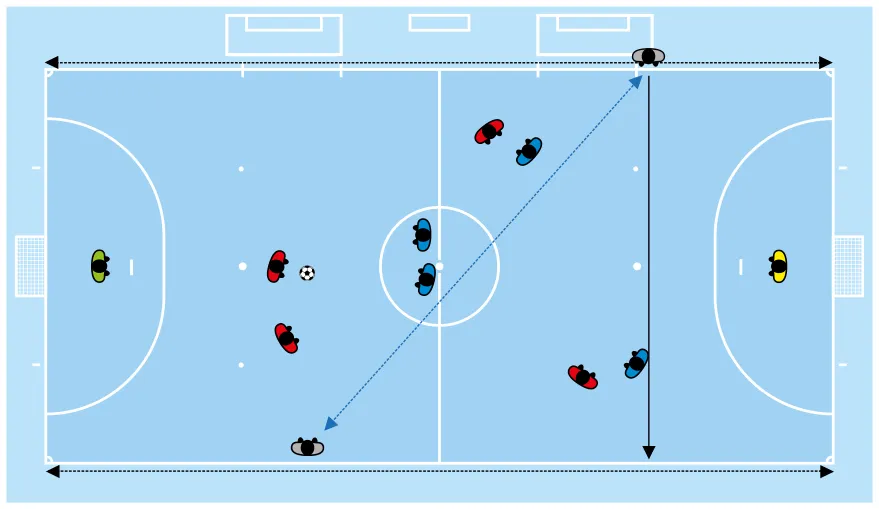
7. Positioning – free kick (3)
Section titled “7. Positioning – free kick (3)”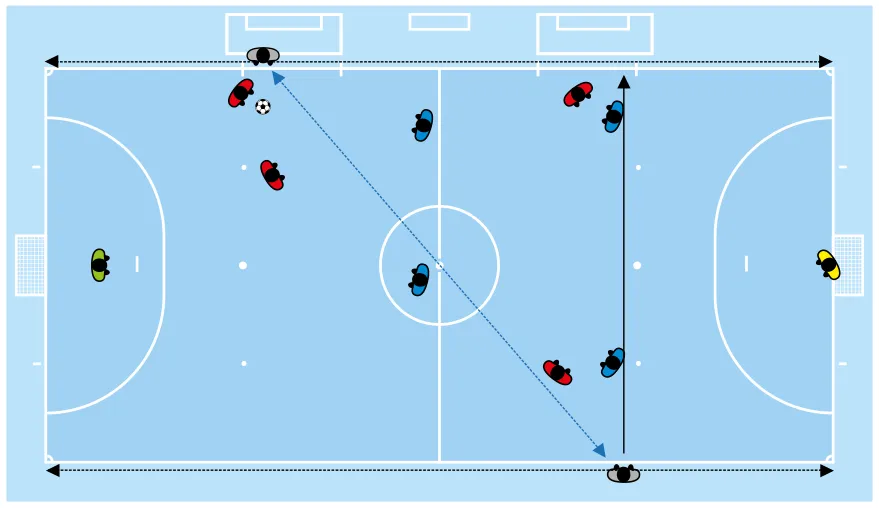
8. Positioning – free kick (4)
Section titled “8. Positioning – free kick (4)”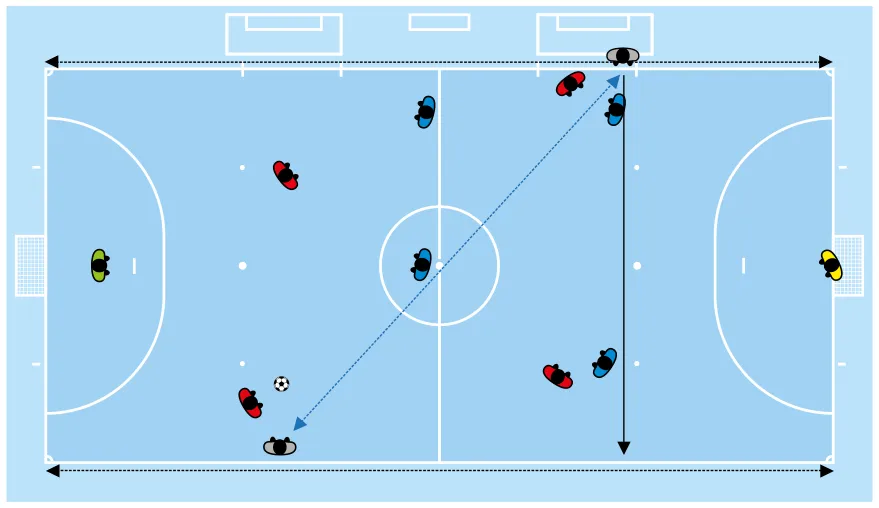
9. Positioning – penalty kick
Section titled “9. Positioning – penalty kick”One of the referees takes a position in line with the penalty mark at an approximate distance of 5m and checks that the ball is properly placed, identifies the kicker and watches the players for encroachment while the kick is being taken. This referee does not order the kick to be taken until it has been checked that the positions of all the players are correct, and may be assisted by the other referee, if necessary. The other referee must be positioned at the intersection of the end line and the penalty area and checks whether the ball enters the goal. If the defending goalkeeper commits a relevant offence in accordance with Law 14 and a goal is not scored, this referee should blow the whistle to order the penalty kick to be retaken.
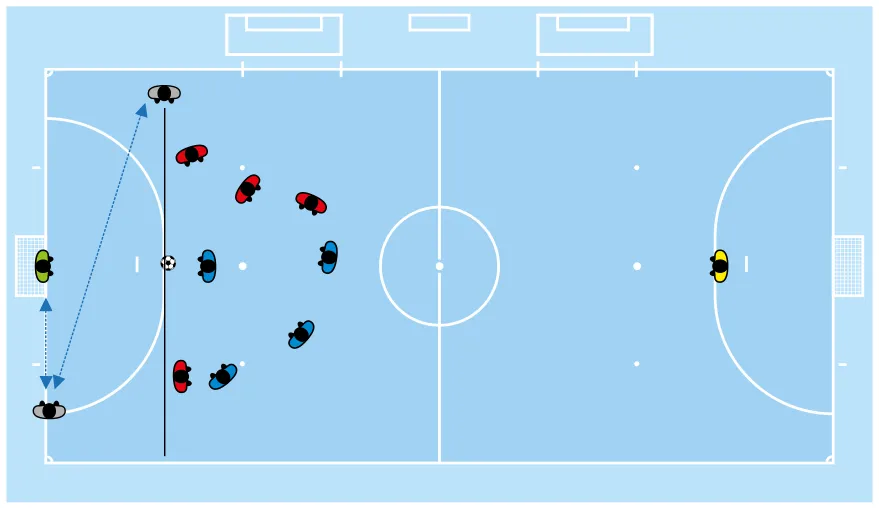
10. Positioning – DFKSAF from the 10m mark
Section titled “10. Positioning – DFKSAF from the 10m mark”One of the referees takes a position in line with the 10m mark, identifies the kicker and watches the players for encroachment while the kick is being taken. This referee does not order the kick to be taken until it has been checked that the positions of the players are correct and the ball is properly placed, and may be assisted by the other referee, if necessary. The other referee must be positioned at the intersection of the end line and the penalty area and checks whether the ball enters the goal. If the defending goalkeeper commits a relevant offence in accordance with Law 13 and a goal is not scored, this referee should blow the whistle to order the DFKSAF to be retaken.
The third referee takes a position in line with the mark inside the penalty area indicating the minimum distance of 5m from the 10m mark that must be respected by the goalkeeper, as mentioned in Law 1.
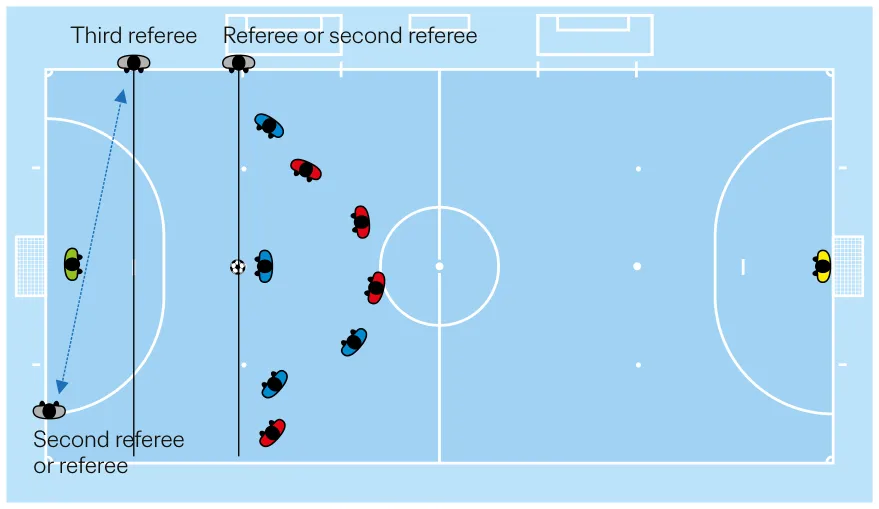
11. Positioning – DFKSAF not from the 10m mark (1)
Section titled “11. Positioning – DFKSAF not from the 10m mark (1)”One of the referees takes a position in line with the ball, checks that the ball is properly placed, identifies the kicker and watches the players for encroachment while the kick is being taken. This referee does not order the kick to be taken until it has been checked that the positions of the players are correct and may be assisted by the other referee, if necessary.
The other referee must be positioned at the intersection of the end line and the penalty area and checks whether the ball enters the goal. If the defending goalkeeper commits a relevant offence in accordance with Law 13 and a goal is not scored, this referee should blow the whistle to order the DFKSAF to be retaken.
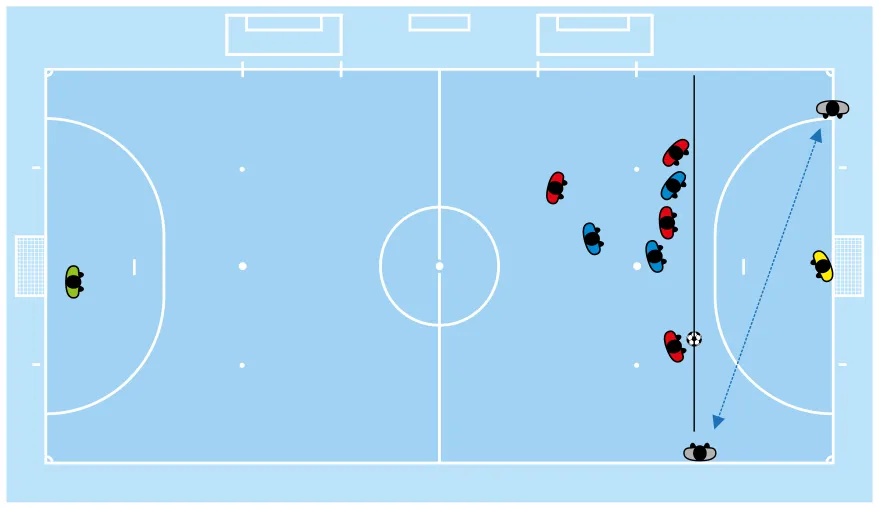
12. Positioning – DFKSAF not from the 10m mark (2)
Section titled “12. Positioning – DFKSAF not from the 10m mark (2)”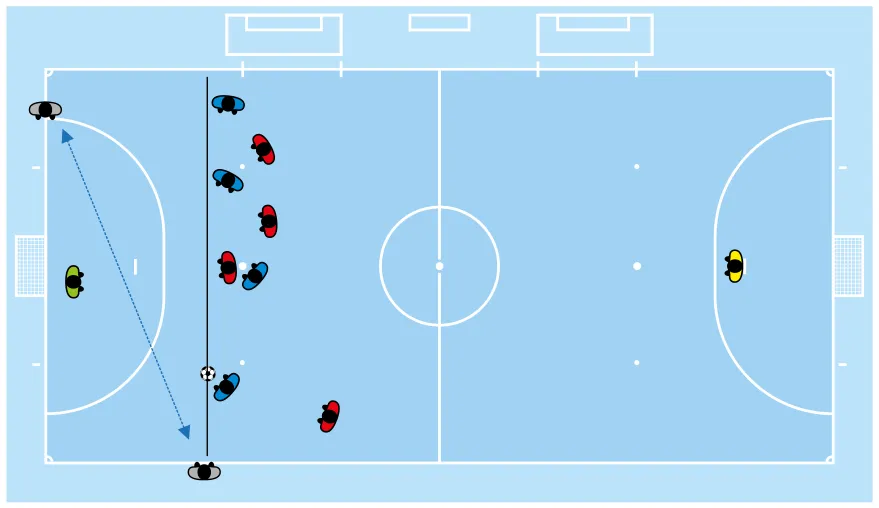
13. Positioning – kick-in (1)
Section titled “13. Positioning – kick-in (1)”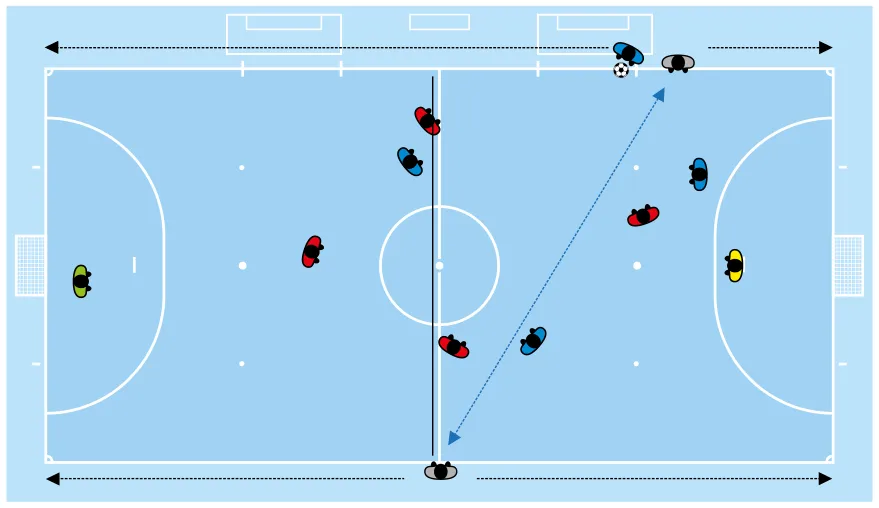
14. Positioning – kick-in (2)
Section titled “14. Positioning – kick-in (2)”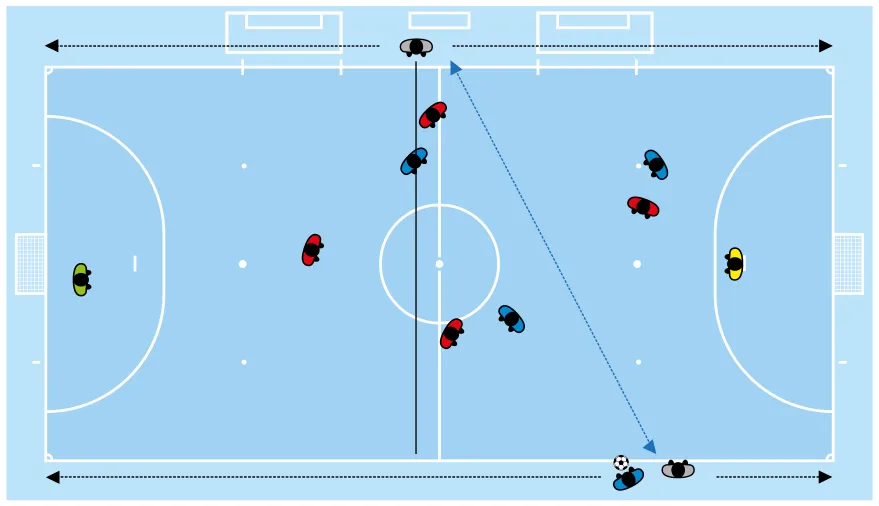
15. Positioning – kick-in (3)
Section titled “15. Positioning – kick-in (3)”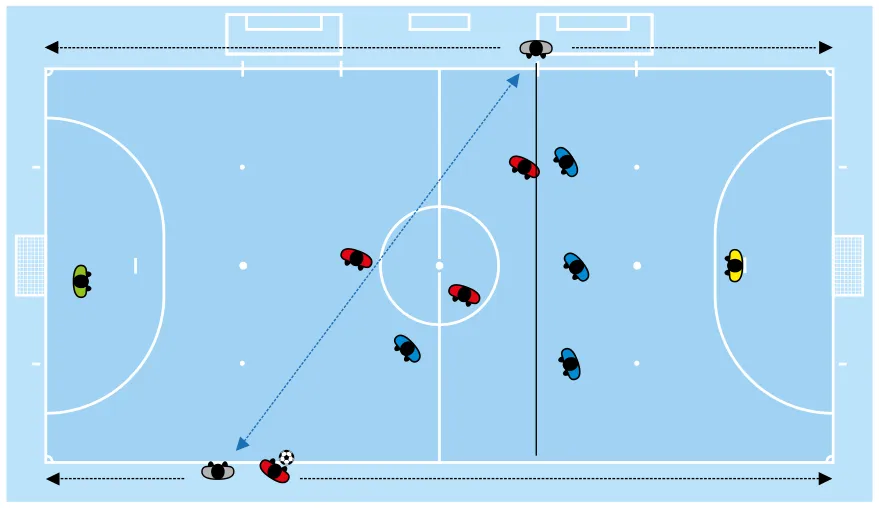
16. Positioning – kick-in (4)
Section titled “16. Positioning – kick-in (4)”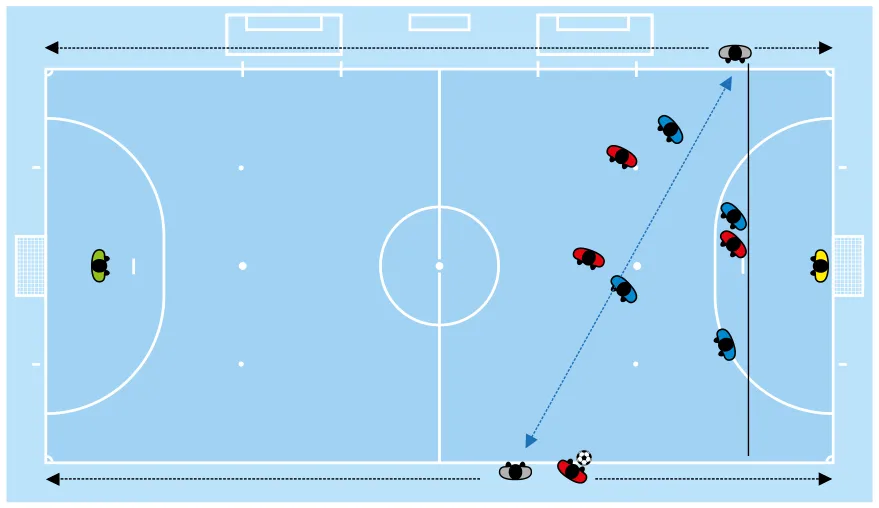
17. Positioning – kick-in (5)
Section titled “17. Positioning – kick-in (5)”At a kick-in close to the corner arc in favour of the attacking team, the referee nearest to the point from where the kick-in is to be taken remains at an approximate distance of 5m. From this position, this referee checks that the kick-in is taken in accordance with the procedure and that the defending-team players are at least 5m from the point from which the kick-in is to be taken. The other referee takes a position at the same end of the pitch but on the other side, at the intersection of the touchline and the end line. From this position, this referee watches the ball and the behaviour of the players.
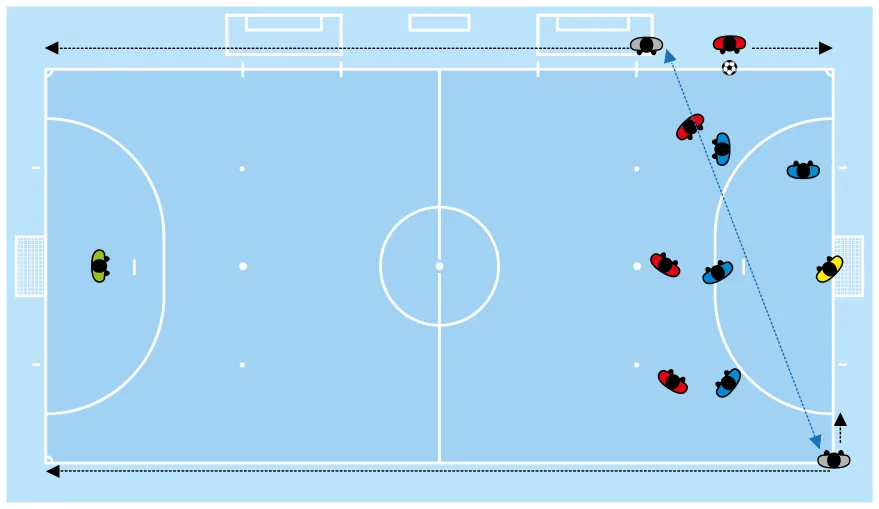
18A. Positioning – penalties (penalty shoot-out) to determine the winners of a match or a home-and-away tie (without a fourth referee)
Section titled “18A. Positioning – penalties (penalty shoot-out) to determine the winners of a match or a home-and-away tie (without a fourth referee)”Taking a position on the end line approximately 2m from the goal, the referee’s main duty is to check whether the ball enters the goal and the goalkeeper complies with the requirements of Law 14.
When it is clear that the ball has entered the goal, the referee must make eye contact with the second referee to check that no offence has been committed.
The second referee takes a position in line with the penalty mark, at an approximate distance of 3m, to check that the ball and the goalkeeper of the kicker’s team are correctly positioned. The second referee blows the whistle for the kick to be taken.
The third referee takes a position in the centre circle to control the remaining eligible players and substitutes of both teams.
The timekeeper takes a position at the timekeeper’s table and ensures that any players excluded from taking a kick and the team officials behave correctly, as well as resetting the scoreboard to 0-0 and recording the outcome of the kicks on the scoreboard.
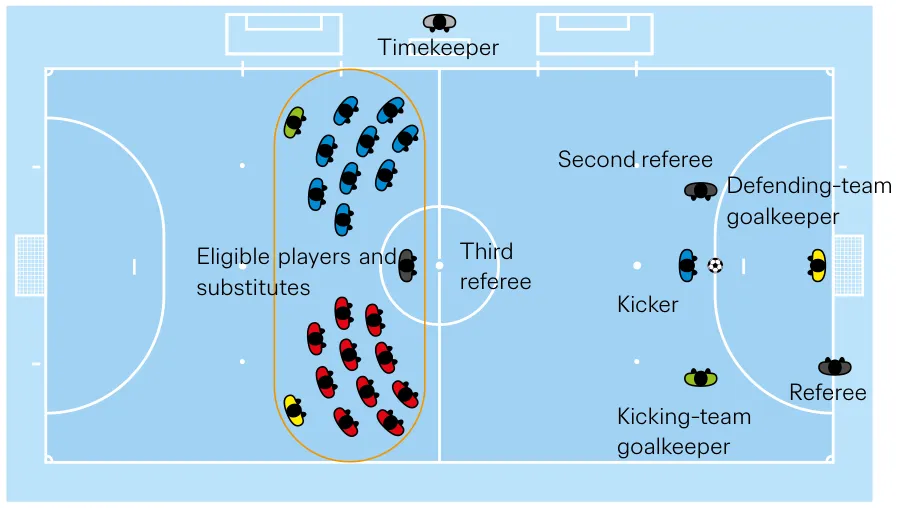
All the match officials make a note of the kicks taken and the numbers of the players who took them.
18B. Positioning – penalties (penalty shoot-out) to determine the winners of a match or a home-and-away tie (with a fourth referee)
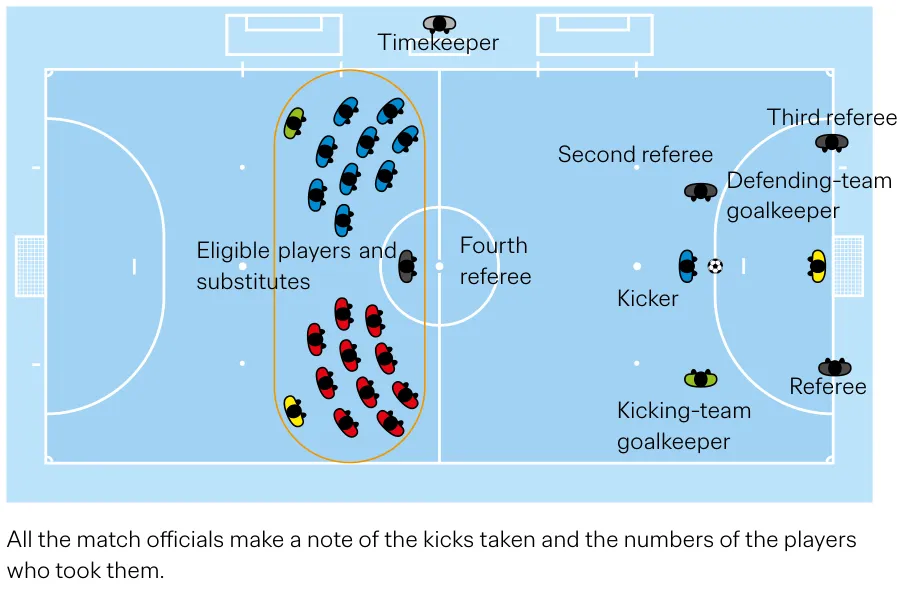
Section titled “18B. Positioning – penalties (penalty shoot-out) to determine the winners of a match or a home-and-away tie (with a fourth referee)”If a fourth referee is appointed, the positions of the match officials are as follows:
The referee takes a position on the end line approximately 2m from the goal. The referee’s main duty is to check whether the ball enters the goal and the goalkeeper complies with the requirements of Law 14.
When it is clear that the ball has entered the goal, the referee must make eye contact with the second and third referees to check that no offence has been committed.
The second referee takes a position in line with the penalty mark, at an approximate distance of 3m, to check that the ball and the goalkeeper of the kicker’s team are correctly positioned. The second referee blows the whistle for the kick to be taken.
The third referee takes a position on the end line approximately 2m from the goal, on the opposite side to the referee. The third referee’s main duty is to check whether the ball enters the goal and assist the referee if needed.
The fourth referee takes a position in the centre circle to control the remaining eligible players and substitutes of both teams.
The timekeeper takes a position at the timekeeper’s table to:
- ensure that any players and substitutes excluded from taking a kick and the team officials behave correctly;
- reset the scoreboard to 0-0 and record the outcome of the kicks on the scoreboard.
19. Positioning – changing of sides by the on-pitch referees
Section titled “19. Positioning – changing of sides by the on-pitch referees”The referees may change sides of the pitch if they consider that it will positively impact the game. However, the referees should bear in mind the following:
- They must not change sides when the ball is in play.
- In principle, they should only change sides when the referee on the bench side shows a YC/RC or makes any other crucial decision which may lead to criticism or dissent from one or more of the teams.
- The referee who shows the YC/RC typically decides whether to change sides or not.
- The referee who is on the bench side after changing sides always signals for the restart.
- The referees may return to their “normal” sides when the game permits.
Examples
Section titled “Examples”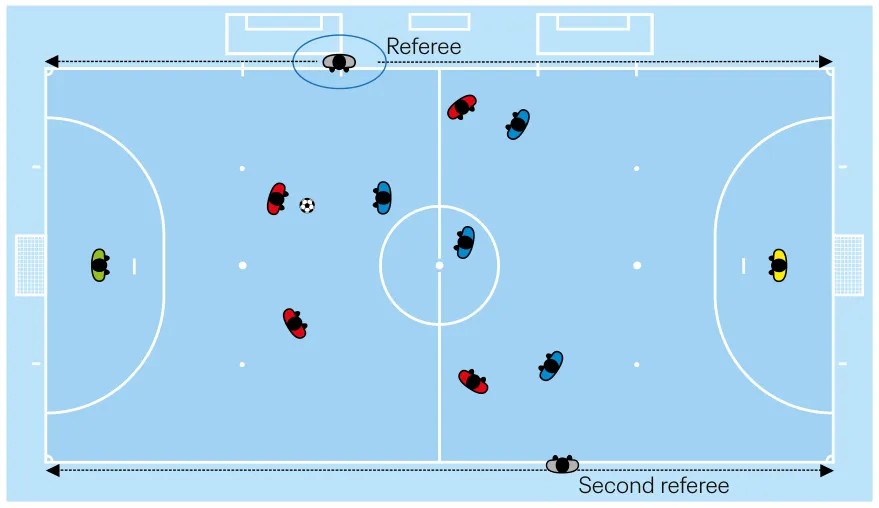
1. The referee near the bench blows the whistle for a foul.
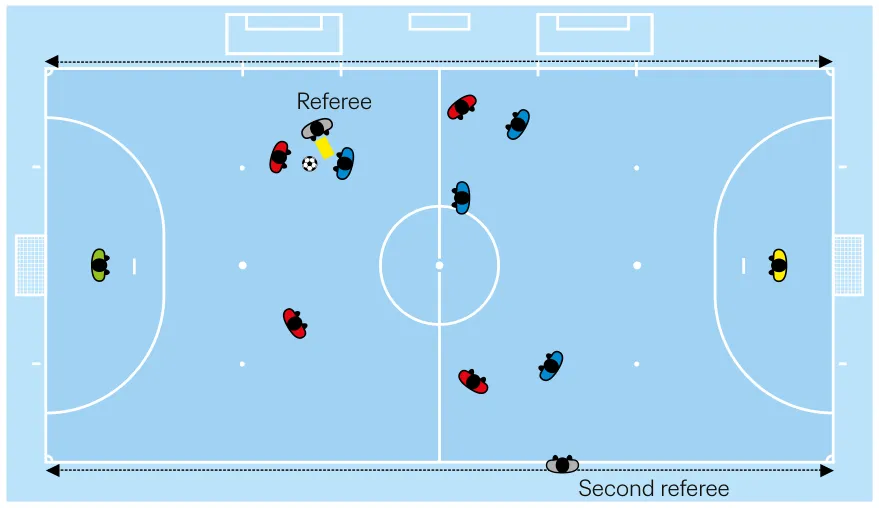
2. The referee who blew the whistle goes to the place where the foul was committed to show a YC/RC.
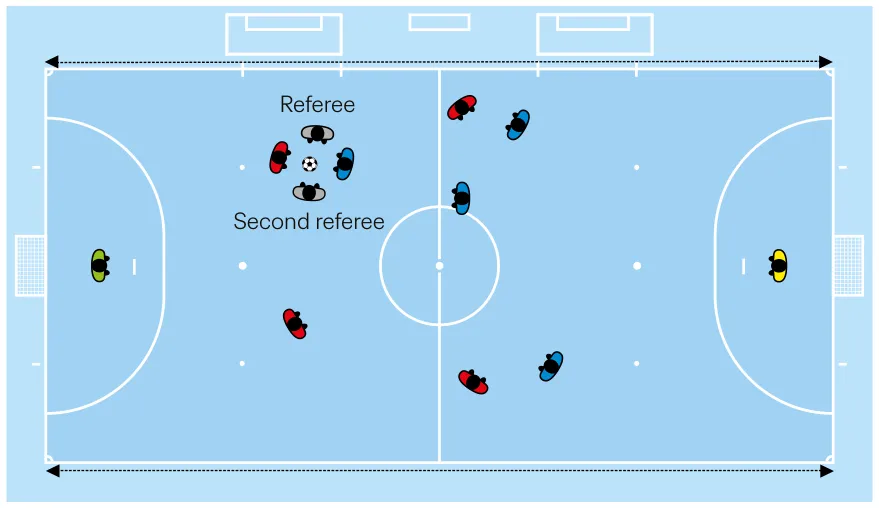
3. The other referee goes to the place where the foul was committed to help control the situation (the players and the ball).
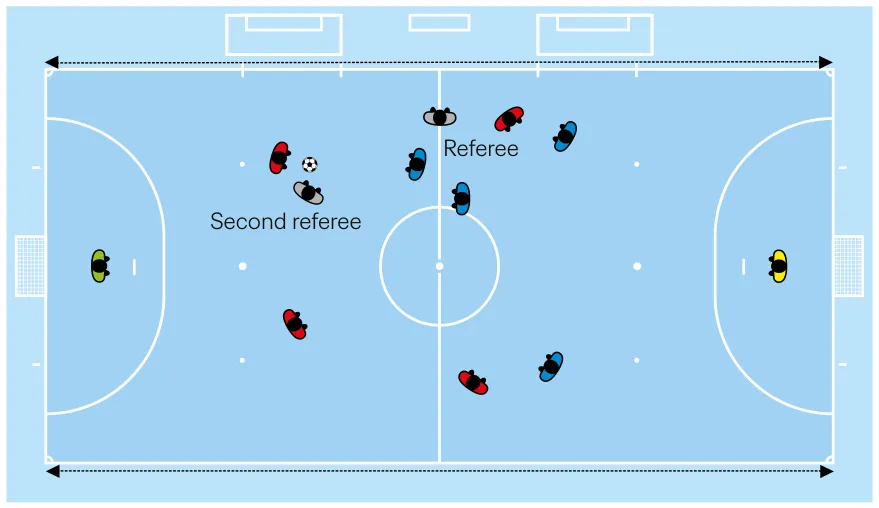
4. The referee who showed the YC/RC goes towards the timekeeper’s table to inform the other match officials of the guilty player’s number. The signal must be made from the halfway line, approximately 5m from the timekeeper’s table.
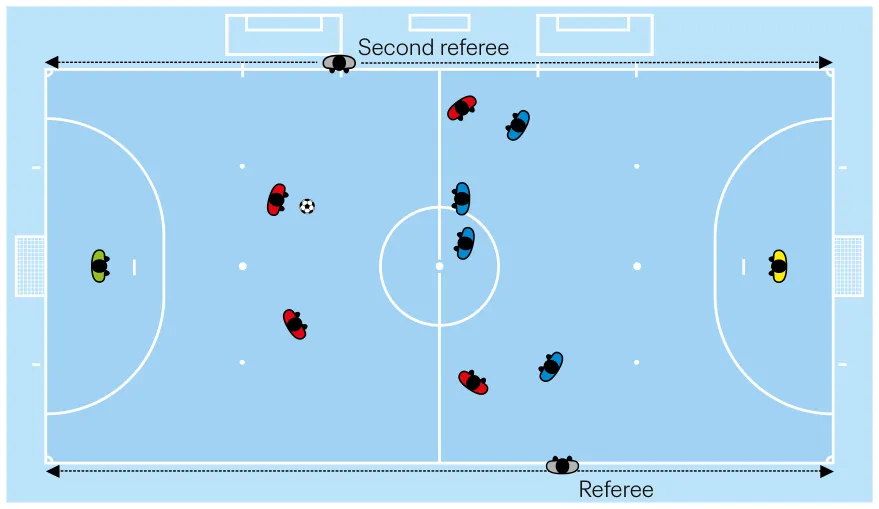
5. The referees restart play having changed sides. Play is restarted by the referee who is now on the bench side blowing the whistle.
20. Positioning – third or fourth referee when one or more teams play with a flying goalkeeper
Section titled “20. Positioning – third or fourth referee when one or more teams play with a flying goalkeeper”When a team plays with a flying goalkeeper, the third or fourth referee controls the goal line of this team when it is attacking. If a goal is scored in the flying goalkeeper’s goal, the third or fourth referee informs the other referees using the approved signal.
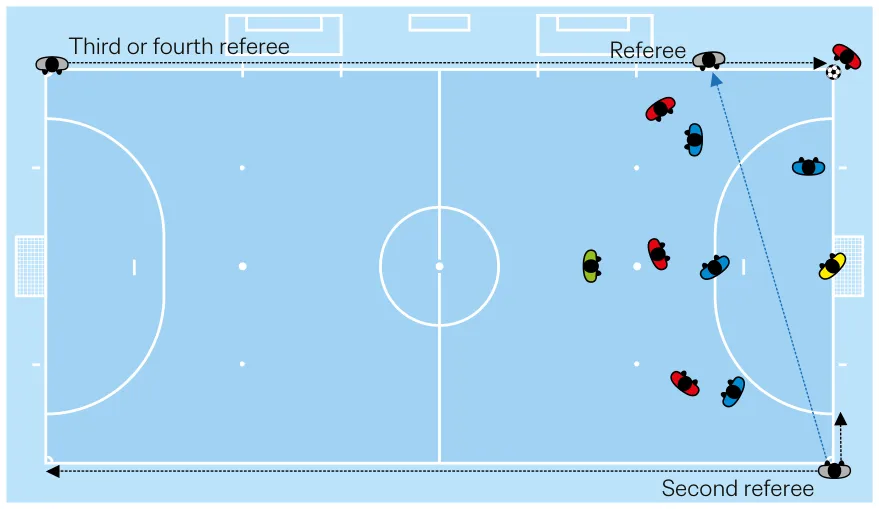
If both teams play with a flying goalkeeper and both a third and fourth referee are available, the third referee should control one team’s goal line and the fourth referee should control the other goal line.